Another possible example of "gratitude-naming"
in the Zohrab family is the naming of Dr. Johannes Zorab's
two eldest children.
Lt.-Col. Dr Johannes Manuk
Zorab,
at some stage, became Superintendant at Brussa Medical School.
The only known "Brussa" is in Turkey, and there is
no known documentation as to whether he ever even went to Turkey.
However, his distant relative, Lady
Fanny Blunt, mentions in Chapter One of her
book, "My Reminiscences," that her father, the
British Consul in Brussa, initiated a plan by the Turkish Sultan
in about 1840 to build a hospital in Brussa. Fanny's uncles
John Zohrab and Dr.
Paul Zohrab, as well as her cousin General
Sir Edward Zohrab Pasha, also had links to Brussa, so it
is quite possible that it was the family connection which got
Johannes a medical job in Turkey.
This is confirmed by a proposed solution to the mystery of
why he gave middle names to his two oldest children which referred
back to close relatives of Fanny Blunt:
Possibly, Mary Sandison (nee Zohrab)
had died by the time Dr. Zorab's eldest son was born
in 1878, and her husband had died in 1869, so he named his
sons after surviving members of that branch of the family,
in gratitude for their help.
Peter was, at various times, an interpreter, accountant, Hokitika
Borough Inspector of Nuisances, auditor, valuator, election agent, newspaper
publisher, auctioneer, builder, farmer, Secretary of a Licensed Victualler's
Association, and international trader. In addition, he acted
illegally as a court lawyer, until cautioned by a judge! According
to Google Books, he is also referred to in Hattersley
(1950) as the "farmer and sportsman who had run the Durban
races...." The same book also says that he had sent
samples (apparently of liquor) to a London merchant, Ingram Travers.
Born in 1817 or 1818 on the Mediterranean island of Malta, he was
a son of Peter Paul John Zohrab and elder
brother of Edward
John Paul Zohrab. According to Lady
Patricia Maddocks' book, he was probably educated in in Bakewell,
Derbyshire, England, where his maternal grandfather and maternal aunt
lived (the latter at the Yew
Tree House), and he married Marianne Walker there in 1840
.
Peter, with his wife and three surviving children, travelled in
July 1850 from the UK to Durban, South Africa on the "Ballengeich",
and he was granted land on the Umhloti
river. He became part-owner of the Natal Times. He imported beer
produced by Edward Zohrab in London. A fourth child, Lillian, was
born in South Africa in 1852. On 15 November 1852 he boarded the "Hannah"
in Port Natal, with his wife and at least some of his children, and
sailed to Port Philip (Melbourne, Australia). He worked there as a
builder and auctioneer.
Peter Zohrab, the pioneer secretary of Prahran municipal movements,
was a man of parts, of 40 years, square shouldered, with black moustache,
running into side whiskers, a large nose, and well-set eyes, half-hidden
with spectacles. He spoke quickly, his matter was good, his manner
assertive.
The first winner (in 1861 and again in 1862) of the Melbourne Cup
was a horse called "Archer", which is described as "William
Tell - Maid of Oaks by Vagabond - Gem from a Zohrab mare". However,
there appears to be no connection with the Zohrab family, since the
horse Zohrab's father had been imported by one Charles Smith.
Peter later moved to the South Island of New Zealand, following
his son Constantine Edward Zohrab, who
had been attracted by the goldrush there. Peter is mentioned
in 1863
Otago Daily Times articles, and in 1864 owned the hotel Belvidere
(which burned down in 1865, under another owner), in Duncan St, Dunedin,
according to the following webpages: http://home.st.net.au/~ailsa/hotellicencees-dunedin.htm
and http://paperspast.natlib.govt.nz/cgi-bin/paperspast?a=d&cl=search&d=ODT18640420.2.14&srpos=77&e=-------100--1-byDA---0Zohrab--.
According to Tod (1984), the only
person who was ever a licensee of this hotel was George Greenfield.
There was a Government Notice in the Otago Daily Times of 15 April
1864, listing Peter Zohrab as applying for a Publican's License for
that hotel, so perhaps he was refused a license and that was the reason
he sold the hotel.
He appears on the 1867-1868 Electoral Roll for what is now the Dunedin
suburb of Roslyn (address: Pine Hill Road, North-East Valley).
Then he appears on the 1868-1869 Electoral Roll for the Westland Boroughs,
with an address in Hamilton street, Hokitika. He lived in Hokitika
for many years, working as Borough Inspector of Nuisances, amongst
other things. His son, Percy, is mentioned as having been the acting
Clerk of the Court of Goldsborough, on the West Coast of the South
Island, in 1877. Another
son, Constantine, seems to have moved to Wellington in 1868, or by
1869, at the latest.
According
to the West Coast Times, Peter must have known at least one of the
following languages: Italian, German and Polish, because in 1879 he
and a man called Meyer travelled to Jackson's Bay to interpret for speakers
of those languages. Italian was probably the language that Peter knew,
since he was born on Malta -- in which case he might have known Maltese
and Arabic as well. While he was there,
the Hokitika Borough Council voted to deprive him of his job as Inspector
of Nuisances, deciding that it should be a Police function. The
Council decision was apparently reversed, because it called for applications
for his job after he resigned.
Peter and his wife had ten children, of whom two died in infancy.
The first four were born in England, one was born in South Africa, and
the rest were born in Australia.
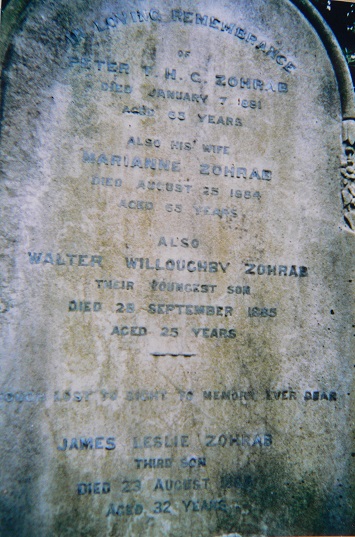
His wife, Marianne,
died in Brougham Street, Mt. Victoria, Wellington, in 1884 and was
also buried in the Bolton Street cemetery. Their son, James Leslie
Zohrab, died at Pirie St., Wellington, in 1888 and was also buried in
the Bolton Street cemetery. Another son, Walter Willoughby Zohrab,
was also buried in the Bolton Street cemetery.
|